
What to Look for to Evaluate the Potential of a Pre-opening Tourism and Resort Project?
2026-05-19
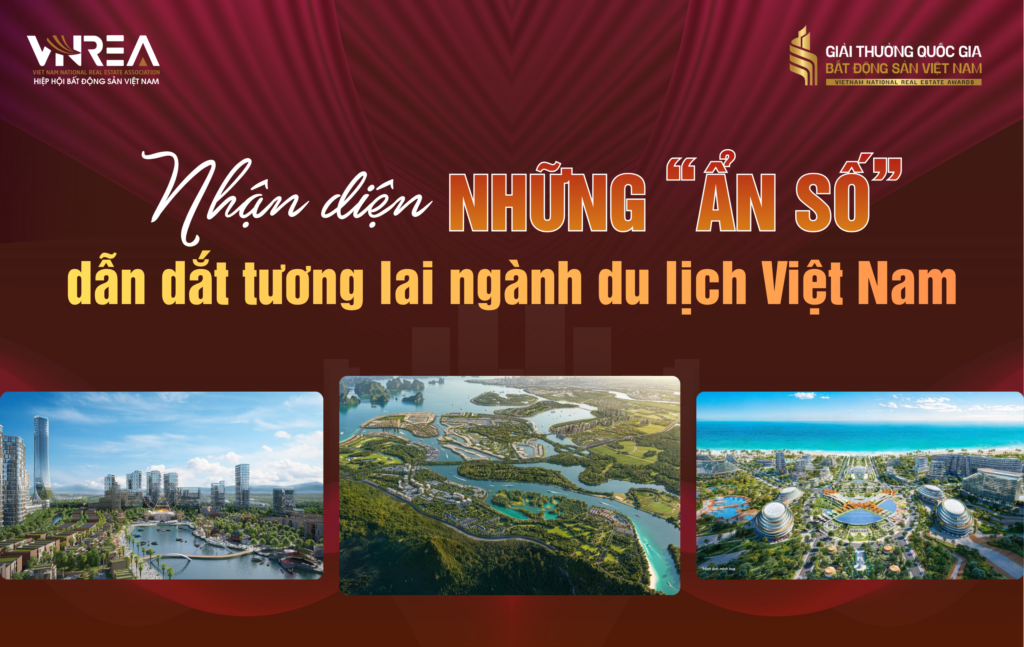
Entering a new stage of national development, the tourism industry is also facing the objective of breaking through into a spearhead economic sector with an integrated and sustainable vision. Amidst this shared aspiration, the Top 10 Most Potential Tourism, Resort, and Entertainment Urban Areas in Vietnam category of the 2nd Vietnam National Real Estate Awards aims to identify new projects capable of elevating Vietnam's tourism standing on the international map.
01
Vietnamese tourism can no longer rely solely on natural advantages to compete
Vietnam's tourism is entering a new development cycle with expectations far greater than just recovering from the COVID-19 pandemic. From an economic sector once heavily impacted by global crises, tourism is gradually becoming one of the key growth drivers of the Vietnamese economy.
In 2025, Vietnam welcomed approximately 22 million international visitor arrivals, an increase of over 25% compared to the previous year; total tourism revenue surpassed the milestone of 1 trillion VND for the first time. Vietnam was also honored as the "World's Leading Heritage Destination" for the 6th time at the 2025 World Travel Awards. Notably, the United Nations World Tourism Organization ranked Vietnam among the countries with the highest international tourism growth rates in the world(1).
Notably, in just the first 4 months of 2026, international arrivals to Vietnam reached 8.8 million - an unprecedented level for the same period and the first time the tourism industry has recorded 4 consecutive months exceeding the milestone of 2 million international visitors per month(2).
These figures not only reflect the strong growth momentum of the smokeless industry but also show that Vietnamese tourism is entering a new competition - where appeal is no longer determined purely by natural resources, but by the quality of experiences, the ability to retain visitors, and the capacity to create distinct values.
In the orientation to formulate the Project on developing tourism into a spearhead economic sector in the new era, tourism is no longer viewed as a standalone service sector, but is placed at the center of the economic - cultural - green - digital - creative ecosystem. This means that next-generation tourism and resort areas are also faced with the requirement to transform.
Once considered the core competitive advantage, a prime location or large scale is no longer enough to make a difference. The market is setting higher demands: diversification and depth of experience, harmony with nature and local values, and enhanced service value.
Prof. Dr. Sc. People's Teacher Vũ Minh Giang, Chairman of the Science and Training Council of Vietnam National University, Hanoi, Vice Chairman of the Vietnam Association of Historical Sciences, Member of the National Cultural Heritage Council, and member of the Final Jury of the 2nd Vietnam National Real Estate Awards, noted that Vietnam possesses two particularly precious "resource mines": cultural heritage and natural heritage. However, while we previously exploited these advantages in a relatively natural way, Vietnamese tourism must now enter a new phase of development – where the advantage lies in the ability to create resort and tourism products with a distinct identity and international standards.
According to him, professionally invested tourism and resort areas that connect nature, culture, and modern experiences not only generate economic value but also contribute to preserving and promoting heritage values and elevating Vietnam's image on the world tourism map.
“It is time for us to create unique tourism products from our existing resource mines through Vietnamese hands, minds, and creativity. This is a field where Vietnamese enterprises can completely and confidently compete on an international level”, Prof. Dr. Sc. People's Teacher Vũ Minh Giang emphasized.
Professionally invested tourism and resort areas that connect nature, culture, and modern experiences not only generate economic value, but also contribute to preserving and promoting heritage values and elevating Vietnam's image on the world tourism map.
It is in this context that the category for Top 10 most potential tourism, resort, and entertainment urban areas in Vietnam under the 2nd Vietnam National Real Estate Awards aims to identify the promising coordinates of Vietnam's tourism in the future.
Rather than simply searching for large-scale projects or those with prime locations, this category focuses on the capacity to create long-term value for the tourism industry, the ability to forge distinct experiences, and contributions to elevating the status of Vietnam's destinations in the new development phase.
First of all, this category focuses on projects currently under development or in the pre-investment stage, which must ensure transparent and clear legal compliance.
Second, strategic location and high potential serve as one of the foundational criteria. However, a "prime location" today is no longer simply understood as having a beautiful beach or impressive scenery. A highly-rated project must be situated within a tourism development space with significant growth headroom, convenient infrastructure connectivity, and the potential to become a future customer magnet.
Third, the criteria of planning and innovative design are also highly valued by the Awards. In the context where tourists increasingly prioritize green resort stays, personalized experiences, and indigenous cultural values, new projects can no longer follow a mass-market motif.
A tourism, resort, and entertainment complex aiming for long-term appeal must build its own destination story; knowing how to connect nature, culture, and services into an experience distinct enough to retain visitors.
Fourth, financial feasibility and implementation progress are also crucial criteria in the selection process. Reality shows that quite a few projects once impressed with grandiose renderings only to experience delayed implementation or a lack of operational resources.
Finally, what the Organizing Committee of the 2nd Vietnam National Real Estate Awards is looking for in projects is the capability to form new "tourism coordinates" that can create long-term value for the tourism industry, the local economy, and the future destination status of Vietnam.
02
"Scoring the future" to find the most potential tourism and resort projects
According to a representative of the Awards Organizing Committee, the fact that participating projects in the category of Top 10 Most Potential Tourism, Resort, and Entertainment Urban Areas in Vietnam are all in the process of implementation or pre-investment makes the evaluation process relatively unique.
If evaluating an operational resort is a matter of existing figures such as occupancy rates, revenue, or guest numbers, selecting a "potential" project is likened to the process of "scoring the future".
This means that the selection process does not stop at investment scale or impressive perspectives on drawings, but requires a deep enough set of criteria to look at long-term development capacity, feasibility, and the value that the project can create for the tourism industry in the future.
According to the Final Jury Council, the biggest difficulty lies in distinguishing between a project that is impressive on paper and one that truly has the potential to become an effectively operated destination in the future.
Because reality shows that quite a few projects possess prime locations, large scales, or eye-catching perspectives but lack long-term operational strategies, lack connectivity with the local tourism ecosystem, or the investors have not proven their practical implementation capabilities.
Conversely, there are projects that are not too large in scale but demonstrate very clear development thinking, from space organization, natural landscape preservation, and local culture exploitation to operational strategy and customer positioning.

Therefore, the evaluation and voting process does not stop at "reading dossiers", but also combines professional critique, legal review, and field surveys so that the Final Jury Council can have a more comprehensive view of project quality, investor capacity, and feasibility.
That is the process of appraising infrastructure implementation capacity, financial potential, investment progress, regional connectivity, and the spillover impact that the project can create for the local tourism industry in the long term.
As recorded by the Final Jury Council of the 2nd Vietnam National Real Estate Awards, the quality of submissions in this season shows a fairly clear shift in the mindset of developing tourism, resort, and entertainment projects in the market.
While many projects in the past primarily competed on scale or profit commitments, those participating in this year's Awards have placed a greater emphasis on experience, green tourism, sustainability, cultural identity, and service personalization.
Numerous tourism and resort areas have demonstrated efforts to combine leisure with wellness, technology, ecological spaces, and local cultural experiences, rather than focusing solely on traditional accommodation.
According to experts, this signals a shift in the resort real estate market toward a more substantive stage of development, where the value of a project is no longer measured primarily by sales speed or short-term profit guarantees.
From a broader perspective, the Final Judging Panel of the Awards noted that the emergence of these potential resort projects also contributes to sanitizing the resort real estate market, which has experienced many fluctuations in recent years.
As financially capable developers with long-term vision and systematic development strategies continue to advance their projects, the market will gradually reshape itself to be more transparent, professional, and based on actual operational value rather than short-term price appreciation expectations.
As Vietnam's tourism enters a new competition of quality and experience, identifying the Top 10 Most Potential Tourism and Resort Areas in Vietnam holds the significance of recognizing projects that will contribute to realizing the strategy of elevating Vietnamese tourism toward high quality, green, sustainable, and culturally rich standards. At the form, it creates destinations competitive enough within the region and gradually affirms Vietnam's position on the international resort map.